I’m reading , at last, having bought it as a birthday present to myself. (It’s not in the library yet, and they’re discussing it chapter by chapter at Ask Moxie , and it’s been on my wishlist for ages, and it was reduced, and so on.) I skipped ahead to the chapter on speech development yesterday, because I’m sure that Mabel’s precocious verbalization will be commented on while we’re away, and I wanted to know what I’m talking about in response.
Call me over-reactive, but somehow, while I’m proud as anything of her speedy speech, something inside me takes any comment on it as an unspoken criticism of Monkey’s more unhurried development in this area way back when he was this age. Which clearly is ridiculous, as if anyone knows or remembers or cares, since he’s chatterboxapaloozaville these days and has been for quite a while, but hey, I’m their mother. Love one, you’d better be damn sure you love them both.
Anyway, I wondered if the book would turn up any clues as to why my kids have developed so differently speechwise. They were both active babies, both early crawlers, both bad sleepers (were? what’s this past tense, paleface?) – but as I may have mentioned, here she is on the cusp of 21 months and talking in sentences, whereas at the same age he was just about to have his long-awaited vocabulary explosion and go from 5 words to 50 in a week or two. Which was perfectly normal for his age – it’s not that he was slow, though I felt as if he was as I watched other kid after other kid come out with two or three or five words at a time. Anyway, why the disparity? Did we do something differently? What could the much-lauded experts tell me?
Well, the book says (to quote my mother, who was ususally talking about Dr Spock) that to help a baby learn to speak, you must not only speak to them but also react favourably to their speech-like vocalizations when they babble back to you. So if you touch or kiss or respond to your four-month-old when she makes a voiced vowel sound, rather than just a cry or a yelp or a bleat or whatever other sounds babies make, you’re showing her that this is the path to take. As they get older, babies learn words better if they hear more than one person repeat them, and with object motion to help them connect the word with the thing they’re looking at. So you wave a ball in front of your 11-month-old’s face and say “ball” in a sing-song voice, and then get a couple of other people to do it, and hey presto, they learn and repeat the word “ball”.
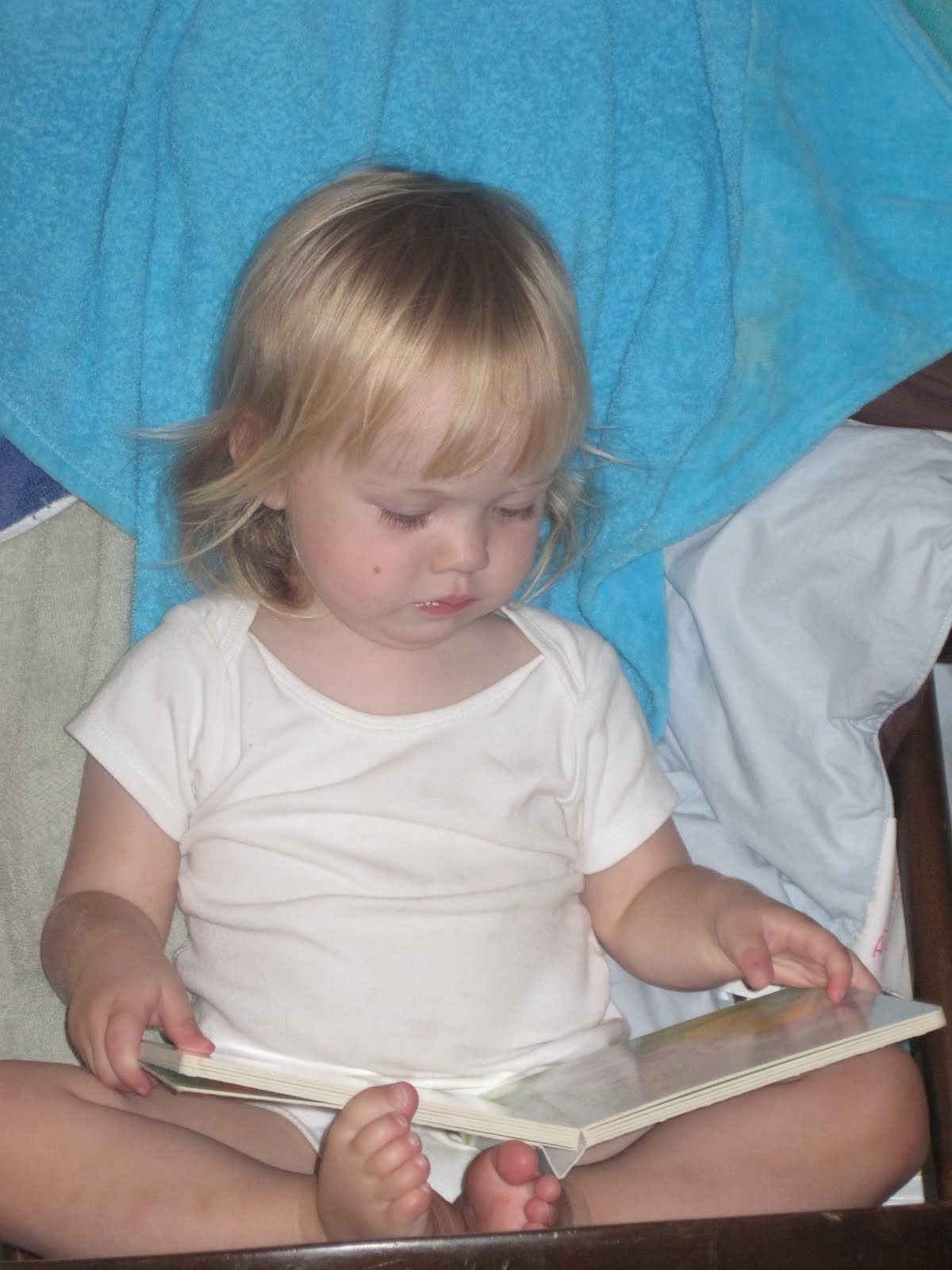 Mabel consults the book
As the second child, Mabel’s experience was obviously different from Monkey’s, since she had him right there in her face from day one, yammering on about Spider-Man or asking for apple juice or whatever he happened to be saying. But I can’t believe we responded any more or differently to her than we did to him at an early age.
So I realised that it’s simply down to their personalities. As I said, they were both active and crawled early, but Monkey walked at 14 months and Mabel at 10 and a half. He’s a cautious kid, for all his crazy antics – whereas she’s just crazy and anticky. It’s not just her reckless, unscientific youth that makes her walk straight into the pool without stopping to wonder where this water might be going as it rises to her neck and above; or climb to the top of the highest swirly slide and come straight down, hair buzzing with static, mouth wide with laughter – she’s that sort of person. And when it comes to talking, she just goes for it and says the word.
Monkey’s receptive language was all there from an early age, and just as he was such a great crawler that he saw no need to walk, he was also such a good communicator – what with the pointing and the nodding and the shaking of the head – that he got all he wanted for a long time without needing to put words to it. He talked when he was good and ready, and that’s how he is. He’ll read, and swim, and ride a bike and all those other things, when he’s good and ready and sure he’s up for it too, and not on anyone else’s schedule.