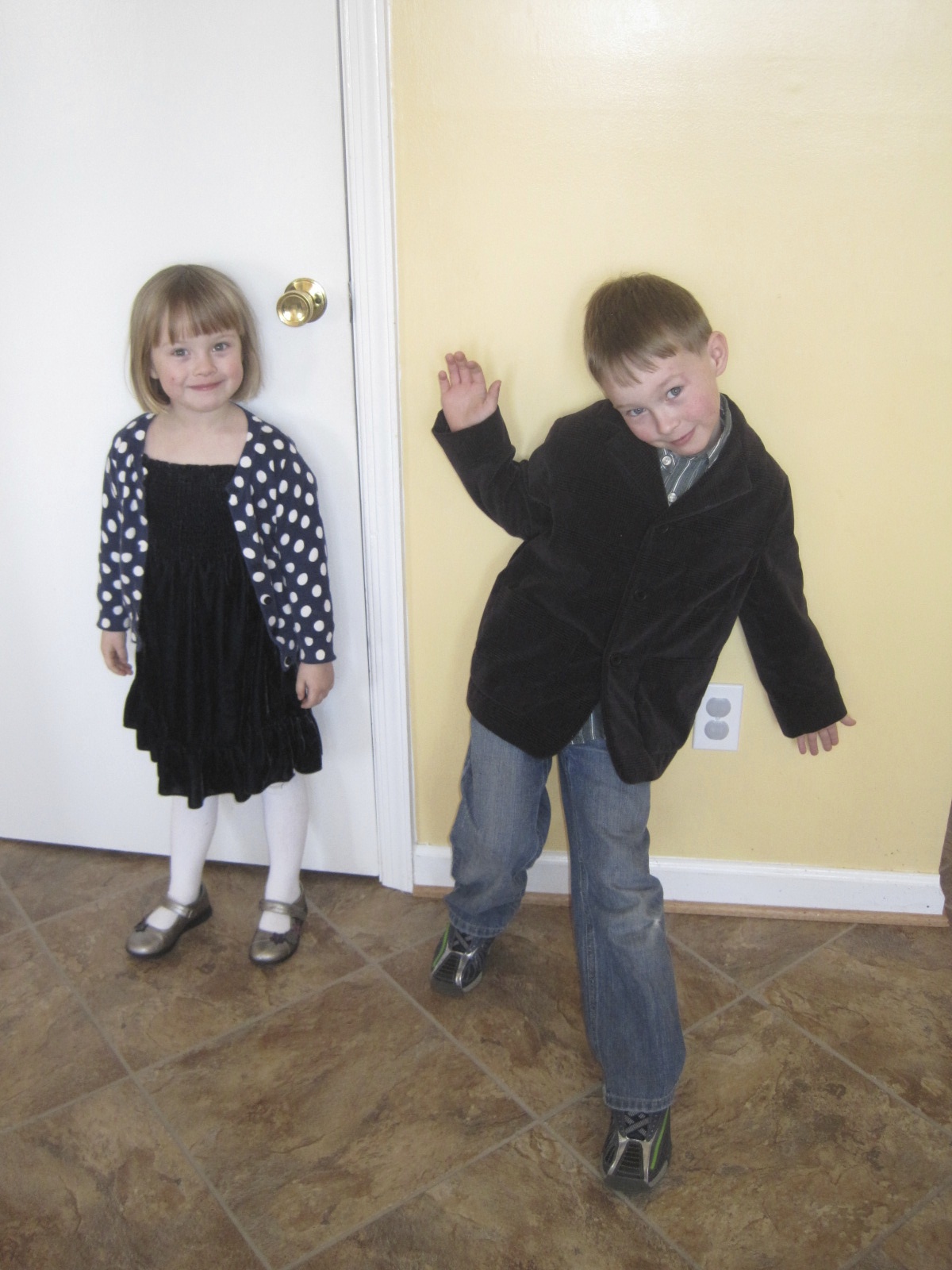
Where is the hilarity, you might ask? Where have all the funny conversations gone? Where’s the real stuff of life? (Wait, it was just Jimmy Durante asking that one.) I dunno, really.
Mabel has
calmed down
, a bit, but Dash has ramped up the anger management issues, and it’s not so funny when he goes all hulk smash on me, because I can’t just hold him at arm’s length and let his not-so-little legs windmill around without connecting. They get my kneecaps every time.
This boy has never been physically violent in his life before. Even as a two-year-old, he’d throw things and rip up books but not hit people. So I’m hopeful that this is a phase; I just hope it burns out soon, before somebody gets hurt. And the rage is always directed at us, the parents: at school he’s doing wonderfully; everyone else thinks he’s the “easy” child – but right now, not so much.
However.
As threatened
, I took
out of the library, and I think it might just be saving my bacon. I even got B to read the first few chapters, though he’s still not as convinced as I am by it – he feels they’re presenting a one-sided argument, while I’ve been totally brainwashed and have decided this is the One True Way. It certainly offers a parenting technique that fits my style and personality, and even now that the initial Come-To-Jesus-ness of it has worn off for me, I’m trying my best to use it, and it’s working often enough for me to remain convinced.
If you don’t know the book, its basic message is empathetic parenting. That sounds all wishy-washy and lovey-dovey, but they give some examples of how you would feel when things aren’t going your way, and people in authority talk down to you, try to coerce you, or ignore you, and I found they really rung true. If I want to teach my children to respect other people and think of their feelings, then I have to start by parenting them that way. The book helps. It gives me tools that I can pass on to them.
It tells me what to do when I don’t know what to do.
I don’t know about you, but I really like that in a parenting book.
For instance. At least three times lately I’ve been faced with a boy who is determined not to give in. Whatever the original issue was, it has come down each time to a refusal to get ready for bed. There is no way to force this with him, and it’s very hard to get a graceful exit. Or any exit, come to think of it.
One of the problem-solving techniques in the book is to make a list of options. Even with a non-reader, you say “I’m going to make a list of the things we could do to work this out” and you sit down with a piece of paper and start writing. You list what the child wants, and what you want, and any number of options in between and around about and totally unrelated. Somehow, the act of doing this, giving his plight the weight that a written list denotes, and appearing to (yes, you’re allowed pretend) seriously consider what he wants to do, helps ground the crazed beast and draw him into the process. With a little luck, you’ll even think of some totally ridiculous options to inject a little levity into the situation.
Then you go through the options together and cross out the ones that aren’t acceptable to you, and the ones he doesn’t agree with. And eventually, magically, something appears that is not remotely related to the matter at hand, and you write it down and draw a big circle around it and he does it and then the whole thing goes away.
I know. It sounds as if it couldn’t possibly work every time. I’m not saying it will. But I am saying that several times now this has got me out of a totally boxed-in corner with Dash. Today I spent an hour asking him to sit down and do his homework. He never did. I told him that he could do double on Thursday (the week’s homework is due on Friday; we don’t have time for more than one day’s worth on Wednesdays), or he could find out what happens when you don’t hand in any homework. But either way, he wasn’t getting to watch his favourite TV show today, because he didn’t do it. He went outside to play after dinner, and when he came in he was under the impression that he could still do his homework and watch his show (on the Internet).
Dash tends to think that time is elastic and that the evening will stretch to fit all the things he wants to do, but bedtime is not so forgiving. When I told him the window on homework, and therefore TV shows, had closed, he had a total meltdown. It wasn’t pretty, but he still thought that his will would prevail. Now, I’m a pushover, but not that much of a pushover, and his way was not an option tonight. We were utterly stuck.
I got out my trusty notebook and a pen, and wrote:
How to get Dash to bed
Then I listed some options, like “Watch his show,” “Watch a 2-minute snippet of his show,” “Go straight to toothbrushing and bedtime stories.” I asked for more suggestions: “Watch ten episodes,” he said. “Watch 16 episodes.” I wrote it all down. “We sit on him until he falls asleep,” I added, for good measure. And “Run naked around the house five times,” since he was refusing to put on his pyjamas.
We started crossing things out. I had no idea where this was going, because we hadn’t yet hit on anything both of us liked. He grabbed my notebook and ran away. I sighed.
Then, out of nowhere, he came up with a new one. “I put on a puppet show of my TV program, and you make a movie out of it [with my camera] and I watch the movie.”
“Oookay,” I said, “but it has to be all done in five minutes, because we’re right up to bedtime now.”
“Okay,” he agreed. We got the camera. His father set the timer for five minutes. Dash picked up two random objects to be the puppets and started making them talk before I’d even found the movie setting. I filmed until (luckily) the camera memory was full. He watched it play back. And then he put on his pyjamas, brushed his teeth, had two very short bedtime stories, and was done.
It took time and dedication, but we resolved the stalemate without violence, without shouting, without tears. I don’t know exactly why it works, but it works. It might just save our sanity.